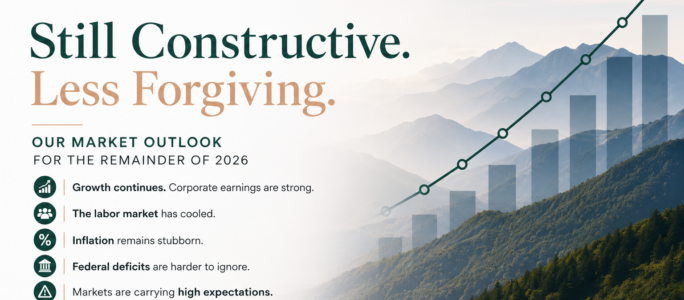
Our Market Outlook for the Remainder of 2026
The U.S. economy is still growing. Corporate profits are strong. Unemployment remains low, and businesses are investing heavily.
At the same time, inflation remains stubborn, hiring has slowed substantially, consumers have become more price-sensitive, federal deficits remain unusually large, and financial markets are carrying high expectations.
We don’t think investors need to choose between calling this economy “strong” or “weak.”
The more useful conclusion is that it remains resilient — but the margin for error has narrowed.
Growth Has Slowed, Not Stopped
Real GDP grew at a 1.5% annualized rate in the second quarter, down from 2.1% in the first.
That headline understates some of the underlying strength. Real final sales to private domestic purchasers — a measure of consumer spending and private investment — grew at a 4.2% annualized rate.[1]
Manufacturing also continues to expand. The August ISM Manufacturing Index registered 54.6, its eighth consecutive month above 50. New orders, production and employment all remained in expansion territory.[2]
So far, this does not look like a conventional recession.
There are signs of strain, particularly among consumers. Real consumer spending was essentially unchanged in July, while the personal savings rate fell to 3.0%.[3]
Households are still spending. Many simply have less cushion.
An economy can continue growing even while more consumers begin to feel squeezed. That appears to be where we are today.
The Labor Market Has Clearly Cooled
Payroll employment declined by 23,000 in July, while unemployment remained relatively low at 4.1%. Perhaps more notably, job growth in May and June was revised lower by a combined 103,000 jobs.[4]
The latest data on job openings tell a similar story. There were 7.3 million openings in July, while hiring, quits and layoffs all changed relatively little.[5]
For several years, the labor-market story was straightforward: employers needed workers, wages were rising and employees had considerable bargaining power.
That period is over.
What has replaced it is not yet a broad layoff cycle. Employers appear reluctant both to hire and to fire.
We would describe the labor market today as stagnant rather than distressed.
That distinction matters, but we are watching it closely. Labor markets can remain stable for a long time and then weaken more quickly than investors expect.
Inflation Is the Bigger Complication
Inflation may be the most important economic variable through year-end.
Consumer prices were 3.4% higher in July than a year earlier. The Federal Reserve’s preferred PCE inflation measure was running at 3.7%, with core PCE at 3.3%.[6]
Those figures are dramatically better than the inflation experienced several years ago.
They are also meaningfully above the Fed’s 2% objective.
And some of the current pressure is coming from areas that interest rates cannot easily solve. Energy prices, transportation costs, tariffs, materials and geopolitical disruptions are all affecting the cost of doing business. The latest ISM survey reinforces the point: its index of prices paid by manufacturers remained at 71.1 in August, signaling continued upward pressure on input costs.[7]
That leaves the Federal Reserve in an uncomfortable position.
At Jackson Hole last week, Fed Chair Kevin Warsh reiterated that the Fed’s 2% inflation objective remains a firm target. Governor Michael Barr went a step further Tuesday morning, saying that if inflation does not moderate sufficiently, he believes the Fed should act decisively to raise rates.[8]
With short-term rates currently at 3.50%–3.75%, the Fed has room to respond if economic conditions deteriorate.[9]
Persistent inflation makes using that room more complicated.
Investors should therefore be careful about assuming that every period of economic weakness will automatically be met with substantially lower interest rates.
Corporate America Remains a Major Positive
The strongest part of the current picture is corporate profitability.
Second-quarter earnings have been exceptionally strong. According to FactSet, 86% of S&P 500 companies reporting through early August exceeded earnings estimates. Importantly, the strength extends well beyond the largest technology companies: the other 493 companies in the index generated blended year-over-year earnings growth of 31.8%.[10]
There is some noise in the headline numbers. Large investment gains at Alphabet and Amazon substantially boosted reported earnings for those companies, so investors should be cautious about extrapolating some of the most spectacular growth rates.[10]
But the broader conclusion remains: corporate America is performing well.
That helps explain an important feature of the current environment.
The economy and the stock market are connected, but they are not the same thing.
A household feeling squeezed by food, energy, insurance or borrowing costs can coexist with a large public company producing record profits.
AI Is Now Part of the Macro Story
The investment cycle surrounding artificial intelligence has become large enough that it is no longer merely a technology-sector story.
Microsoft expects approximately $175 billion of capital expenditures during calendar 2026. Alphabet has raised its estimate to $195–205 billion. Meta expects $130–145 billion.[11]
Those three companies alone are contemplating roughly half a trillion dollars of investment in a single year.
Today, that spending supports semiconductor manufacturers, data centers, electrical infrastructure, power generation, construction and an expanding network of suppliers. Federal Reserve officials have identified the AI-related investment boom as an important contributor to current economic growth.[12]
Longer term, however, investors should ask an obvious question:
Will the economic return ultimately justify the amount of capital being invested?
We don’t know yet.
Artificial intelligence may prove to be one of the great productivity investments of our lifetime.
It is also possible for a transformative technology to attract too much capital, too quickly, at valuations that assume too much future success.
Both things can be true.
The Fiscal Situation Is Harder to Ignore
There is another issue we believe deserves more attention than it typically receives in market commentary.
The Congressional Budget Office projects a federal deficit of approximately $1.9 trillion for fiscal 2026, equal to 5.8% of GDP. Federal debt held by the public is approximately 101% of GDP.
For comparison, federal deficits have averaged 3.8% of GDP over the past 50 years.[13]
Large deficits are not new.
What is unusual is running deficits of this size with unemployment near 4%.
This does not mean a fiscal crisis is imminent, and federal debt is not a useful tool for predicting next month’s stock market.
But the arithmetic matters.
Persistent government borrowing increases interest expense and can contribute to pressure on longer-term borrowing costs. Perhaps more importantly, running large deficits during relatively good economic conditions reduces the fiscal flexibility available when the next recession eventually arrives.
This is not a partisan observation. The trajectory has developed over many years and under governments of both parties.
For investors, the relevant questions are interest rates, inflation, economic growth and ultimately the government’s capacity to finance its obligations at a reasonable cost.
What It Means for Portfolios
Our outlook remains constructive.
The economy continues to grow. Corporate profitability is strong. Business investment is substantial. Technological innovation is accelerating. We do not currently see the broad contraction normally associated with recession.
But we also do not think this is an environment that rewards complacency.
Inflation remains stubborn. Labor-market momentum has weakened. Longer-term interest rates remain elevated. Fiscal policy remains unusually loose, and an enormous amount of capital and investor enthusiasm is now attached to the future economic value of AI.
Our response is not to make a dramatic market call.
It is to build portfolios that do not require us to get one exactly right.
We want meaningful participation in long-term equity growth without unnecessary concentration. We want high-quality fixed income now that bonds can once again provide meaningful income as well as diversification. We want exposure beyond the handful of companies that dominate market headlines. And, where appropriate, we want additional sources of return that are not entirely dependent on stocks continuing to become more expensive.
There will always be a persuasive argument for getting out of the market.
There will usually be an equally persuasive argument for chasing whatever has recently worked best.
Neither is an investment process.
There is plenty to be optimistic about in the U.S. economy and markets.
There are also legitimate risks that should not be waved away simply because asset prices have been rising.
The backdrop is still constructive. It is simply less forgiving.
Sources
[1] U.S. Bureau of Economic Analysis, GDP (Second Estimate) and Corporate Profits, 2nd Quarter 2026, August 26, 2026.
[2] Institute for Supply Management, Manufacturing PMI Report, August 2026.
[3] U.S. Bureau of Economic Analysis, Personal Income and Outlays, July 2026, August 26, 2026.
[4] U.S. Bureau of Labor Statistics, The Employment Situation — July 2026, August 7, 2026.
[5] U.S. Bureau of Labor Statistics, Job Openings and Labor Turnover — July 2026, September 1, 2026.
[6] U.S. Bureau of Labor Statistics, Consumer Price Index — July 2026, August 12, 2026; U.S. Bureau of Economic Analysis, Personal Income and Outlays, July 2026.
[7] Institute for Supply Management, Manufacturing PMI Report, August 2026.
[8] Federal Reserve Board, Chairman Kevin Warsh, In Our Time, Jackson Hole Economic Policy Symposium, August 28, 2026; Governor Michael S. Barr, remarks on the economic outlook, September 1, 2026.
[9] Federal Reserve Board, Minutes of the Federal Open Market Committee, July 28–29, 2026.
[10] FactSet, S&P 500 Earnings Season Update: August 7, 2026 and subsequent Q2 earnings analysis.
[11] Microsoft, FY2026 fourth-quarter earnings call; Meta Platforms, Second Quarter 2026 Results; Alphabet 2026 capital-expenditure guidance.
[12] Federal Reserve Board, Governor Michael S. Barr, September 1, 2026 economic remarks.
[13] Congressional Budget Office, The Budget and Economic Outlook: 2026 to 2036, February 2026.
This material is for general information and educational purposes only and is not intended to provide specific advice or recommendations for any individual. Investing involves risk including the loss of principal. There is no assurance that the views or strategies discussed are suitable for all investors or will yield positive outcomes.